
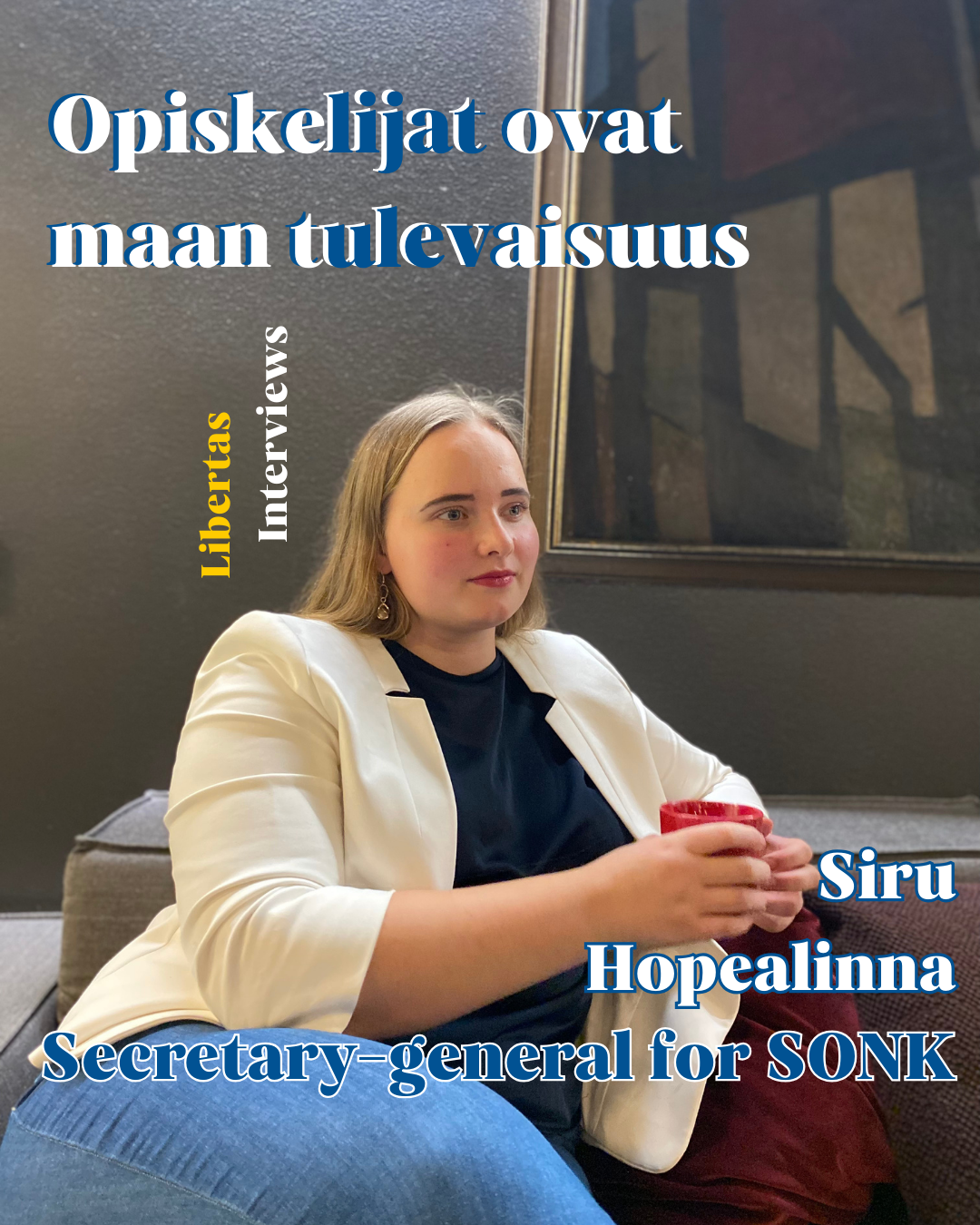
Sosialidemokraattisten Opiskelijoiden pääsihteeri (General Secretary) Siru Hopealinna is, a 23-year-old engineering graduate and studies administrative sciences at the University of Vaasa. Since October 2025 she has served as secretary-general of the Finnish Social Democratic student union — SONK .
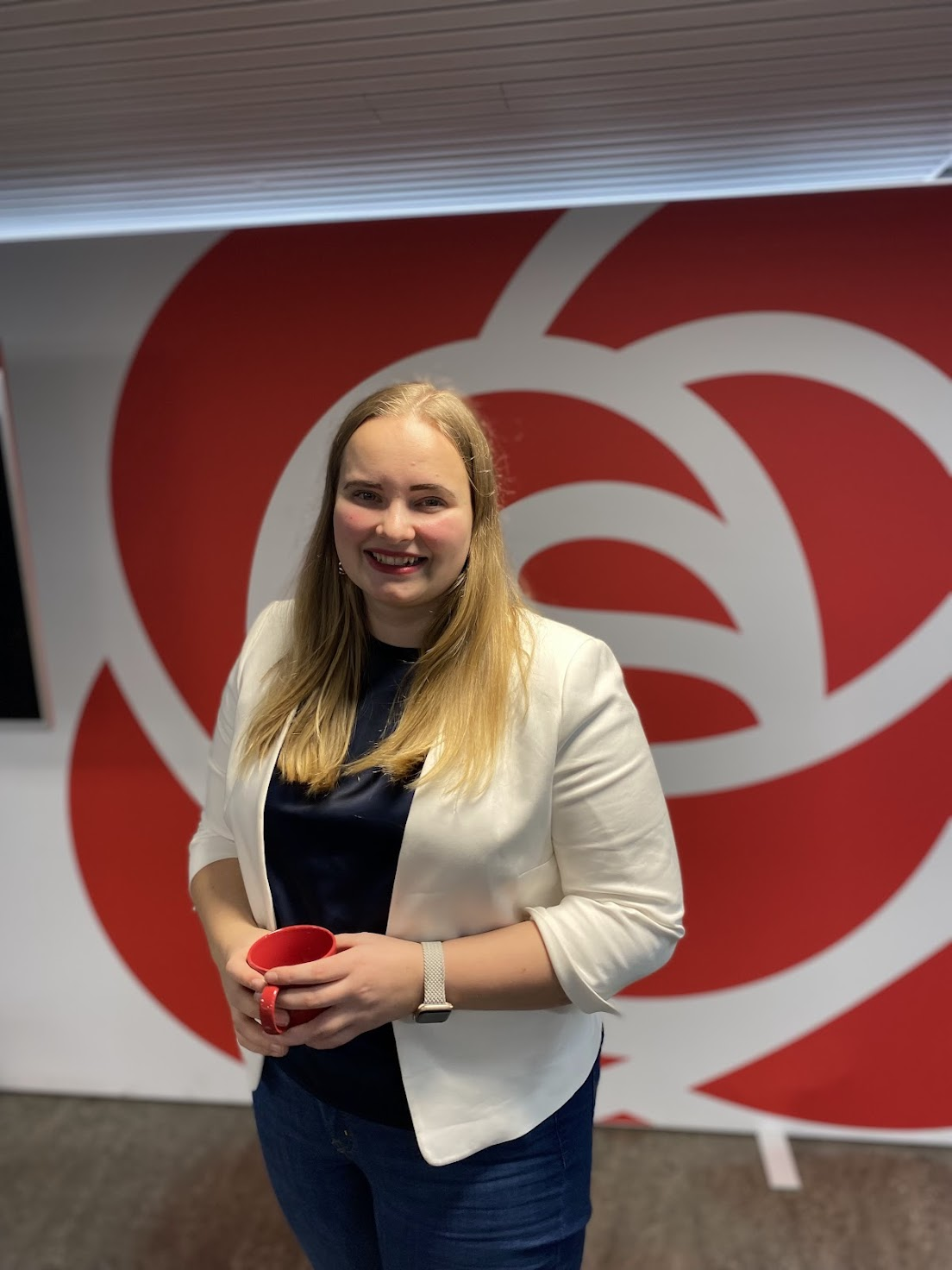
During a visit, I had the opportunity to meet and follow Siru Hopealinna for an entire day at the Finnish Social Democrats’ party headquarters in central Helsinki, despite her busy schedule. She meets me, while I am wandering around trying to find the entrance to the massive cylindrical building, overlooking the lake and the central railway station in the gray rain. After a tour of the floor, which houses the party’s premises, offices, affiliated organizations, and the editorial office of the party newspaper, we sit down in SONK’s union office.
Text and picture: Erik Solfors
Part I
SONK and Suomen Sosialidemokraattinen Puolue (SDP)
What is SONK?
– “SONK is the Social Democratic students in Finland. It’s… well, the student union, simply put.”
The Social Democratic students were founded in 1963, in the middle of a period when universities became political arenas. During the 1950s the prevailing idea had been that academia should stand outside party politics. But the social upheavals of the 1960s made that separation impossible.
– “In the 1950s people thought politics and students shouldn’t mix. But in the 1960s politics took a much stronger place at universities.”
Local student groups already existed, but the need for a national structure became clear as university politics began to mirror national politics. The union was created to gather the movement - and to lead it.
Today the organization is nationwide. Local associations exist in the major university cities: Helsinki, Turku, Tampere, Oulu, and Rovaniemi. Universities of applied sciences are harder to organize; they are younger institutions spread across smaller towns.
Regardless of structure, the student movement lives in a permanent campaign mode.
In Finland, student politics never pauses. There is no quiet period, no real off-season. Elections follow each other at a pace that would exhaust many national party organizations.
Hopealinna describes it almost like a force of nature.
– “Universities have elections every other year. Universities of applied sciences have elections every year. That means we are campaigning practically all the time.”
The student movement lives in constant mobilization. Posters, lists, campaign meetings — the cycle restarts as soon as it ends. National elections could crush such a rhythm, but the calendar creates a peculiar balance.
– “Luckily parliamentary, regional, and municipal elections are usually in the spring, while student elections are in November. So we get a little rest before we start again.”
It is rest in a relative sense. Politics never stops.
What does your relationship with the mother party look like?
– “We have a close relationship with the party. Our offices are on the same floor.”
It’s not just symbolic. The student union regularly participates in parliamentary group meetings and party board work.
– “We attend meetings every other week. Every couple of months we present our work.”
When student issues risk being sidelined, there is still a line.
– “We cooperate, but we can also be radical on student issues when necessary.”
It’s an internal tension that keeps the movement alive.
When you become a member of SONK, what does a normal membership meeting look like?
Membership in the student union is not just meetings and minutes. It is also a culture.
– “Sauna is a very traditional Finnish thing.”
Local organizations arrange sauna evenings several times a year. Sometimes they are combined with cultural introductions for international students.
– “We explain Finnish politics — in the sauna.”
Sometimes these sauna meetings are complemented by ice swimming — or avanto, as it is called in Finland.
– “You cut a hole in the ice and swim.”
Other evenings are simpler: pizza and politics, wine and politics. Low-threshold gatherings where new members can enter without feeling they need to be experts.
[The person responsible for this interview is not jealous at all.]
What does the union’s long-term plan look like?
The union is in a growth period — but Hopealinna reminds how close it came to collapse.
– “We have just under 800 members now. In September 2024 we only had around 240. There was even discussion about whether SONK would continue to exist.”
It’s a dramatic swing in a year.
– “Now we’re stable again and growing.”
That number carries relief. The movement survived. Today there are hopes of establishing a presence in more student cities, at more institutions, and attracting more students.
The union’s long-term political goals revolve mainly around student finances.
– “The biggest goal is student financial support.”
Today student aid is around €1,080 per month, of which €280 is a grant and €850 is a loan.
– “Students graduate with €20,000–30,000 in debt.”
After studies comes not security, but repayment.
– “People should be able to start working, build families, buy homes. Instead they spend years paying off debt before they feel secure.”
The union pushes the idea that education should not require a lifelong financial head start.
– “Everyone should be able to study without heavy debt.”
Part II
Finlands political system and being in opposition
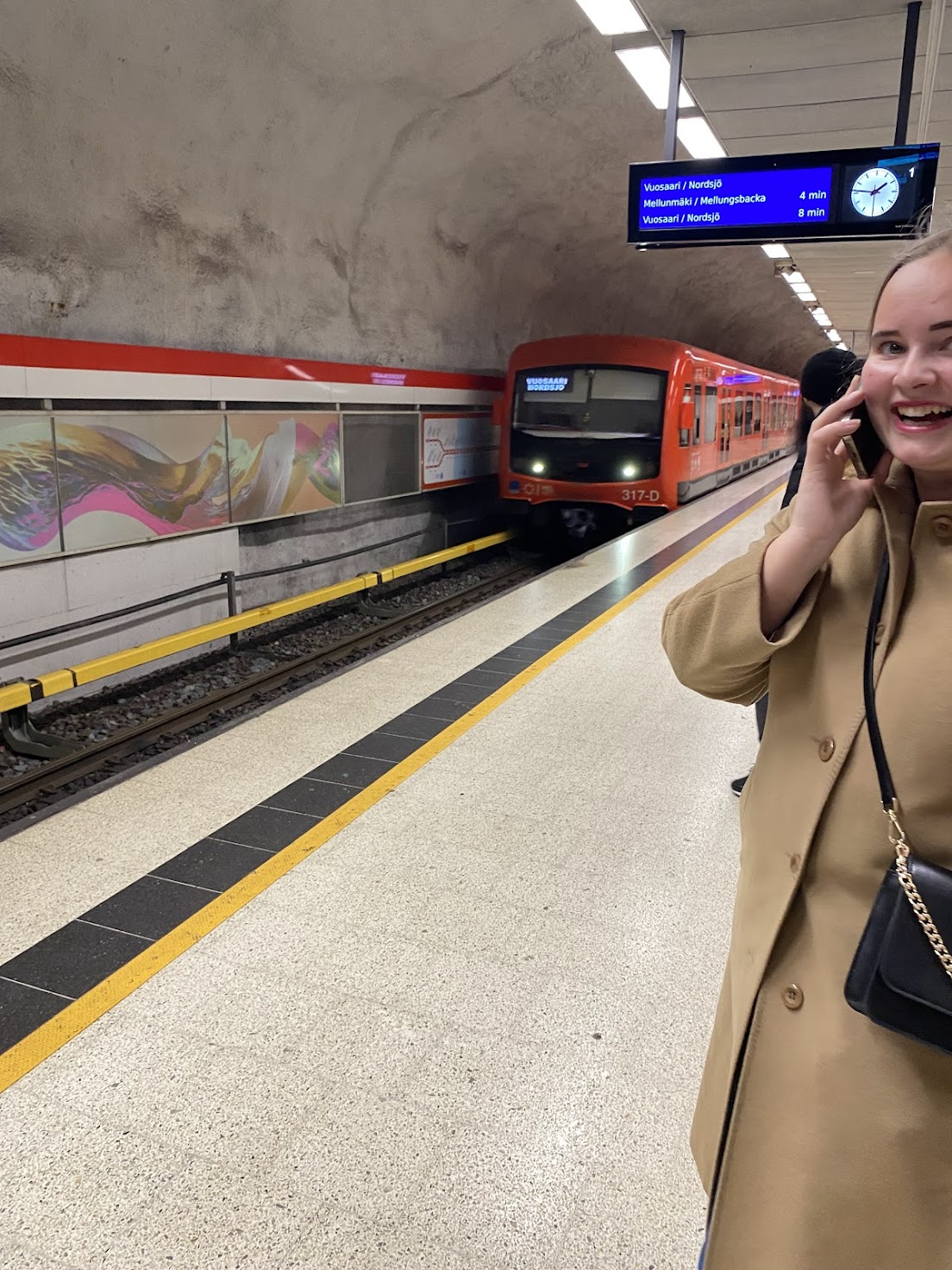
The rain hasn’t stopped when we leave the party headquarters. Helsinki is muted in gray, the sidewalks shining with water. We take the metro toward parliament, the massive granite building rising over Mannerheimintie. For Siru Hopealinna it is everyday life — but not routine.
Student politics is closely tied to national politics, and in Finland the boundary between them is thinner than one might think.
She describes the political system as practical. In Finland people do not primarily vote for parties, but for individuals within party lists. That makes politics more personal — and more direct.
At the same time, it is a multi-level system: municipalities, welfare regions, parliament every four years, the EU Parliament every five years, and a presidential election every six years.
Nationally, parliament and the president are elected. Regionally, councils are elected in the welfare regions responsible for healthcare and social services. Locally, municipal councils are elected to govern municipal operations. For students, politics is felt in everyday life on all these levels: healthcare, education, housing.
For Swedes, Finland’s welfare regions can be seen as a simplified equivalent of Sweden’s regions. In Finland they are an administrative layer created to gather healthcare, social services, and rescue services under regional governance. They are not historical provinces but practical service areas — roughly comparable to regions, but with a clearer welfare focus.
Eduskunnan (riksdagen) partier
Left Alliance (Vasemmistoliitto)
The clearest left-wing party. Socialist roots, strong welfare profile, and focus on equality and labor rights. More pragmatic than its historical legacy suggests and often functions as a support party to Social Democratic governments.
Social Democrats (SDP)
A classic social democratic governing party. Defends the welfare state, labor rights, and the public sector, but pragmatic in economic matters. Comparable to the Swedish Social Democrats, with greater emphasis on industrial policy and national stability. Long one of Finland’s two state-bearing parties.
The Greens (Vihreät)
An urban green left/social liberal party with a strong base among young and highly educated voters. Combines climate politics with progressive values. Comparable to the Green Party in Sweden.
Swedish People’s Party (SFP/RKP)
A social liberal centrist party representing the Swedish-speaking minority. Pro-EU, institutionally stable, and often a bridge-builder in coalition governments.
Centre Party (Keskusta)
Historically an agrarian governing party. Defends rural interests, decentralization, and regional policy. Similar to the Swedish Centre Party’s agrarian roots, but more pragmatic than ideological. Has lost significant support.
Movement Now (Liike Nyt)
A technocratic centrist project. Business-friendly, anti-establishment, and less ideological than most other parties. Profiles itself around efficiency and reform.
National Coalition Party (Kokoomus)
The major bourgeois right-wing party. Market-liberal, pro-EU, and urban-oriented. Comparable to the Moderates in Sweden but more economically liberal. A classic governing party.
Christian Democrats (KD)
A small social conservative party with a Christian value base. Focuses on family policy and moral issues rather than economic ideology.
Finns Party (Perussuomalaiset)
A right-wing populist and nationalist party. Immigration criticism and EU skepticism are central. Comparable to the Sweden Democrats but with stronger economically left-populist elements. Has become one of the country’s largest parties.
Åland elects its own member of parliament who primarily represents the region’s autonomy — Åland also has its own political parties.
Nationally the Social Democrats lead in opinion polls. But university corridors do not always reflect the country as a whole.
– “In the polls we’re around 24–25 percent and currently the largest party. But among students the left is often more popular. Student politics sits somewhat further left than national politics.”
Finland is currently governed by a right-wing coalition in which a populist nationalist party — the Finns Party — succeeded in attracting working-class votes in the last election. According to Hopealinna, governing responsibility has quickly changed perceptions.
– “Those voters are coming back to us.”
She speaks not in slogans but in consequences. The Social Democrats recently performed strongly in the welfare region and municipal elections held in spring 2025.
– “Yes, we came first in those elections.”
It is a short sentence, but it carries weight. Welfare region elections in Finland concern the infrastructure of welfare: healthcare, social services, rescue services. This is politics at the level where decisions quickly produce concrete consequences. According to Hopealinna, their success was built on the government’s broken promises to defend workers and welfare.
– “The far-right party promised to protect workers and social benefits but is cutting support and focusing heavily on immigration policy.”
When governing policy became reality, a gap emerged between rhetoric and action.
– “They betrayed their voters.”
And the consequences are visible.
– “It helps us grow.”
It is not triumphalism. It is an analysis of a political cycle: promises, disappointment, return.
The student movement follows developments closely. Every welfare cut makes student issues more urgent. Every broken promise shifts political energy.
At the same time, she argues that the government is pushing the hardest decisions forward.
– “They’re pushing responsibility ahead of the next government.”
It is a strategy that creates political debt rather than economic balance.
For students, the effect is concrete: lower financial support, higher living costs, greater pressure.
Part III
Student politics and housing issue
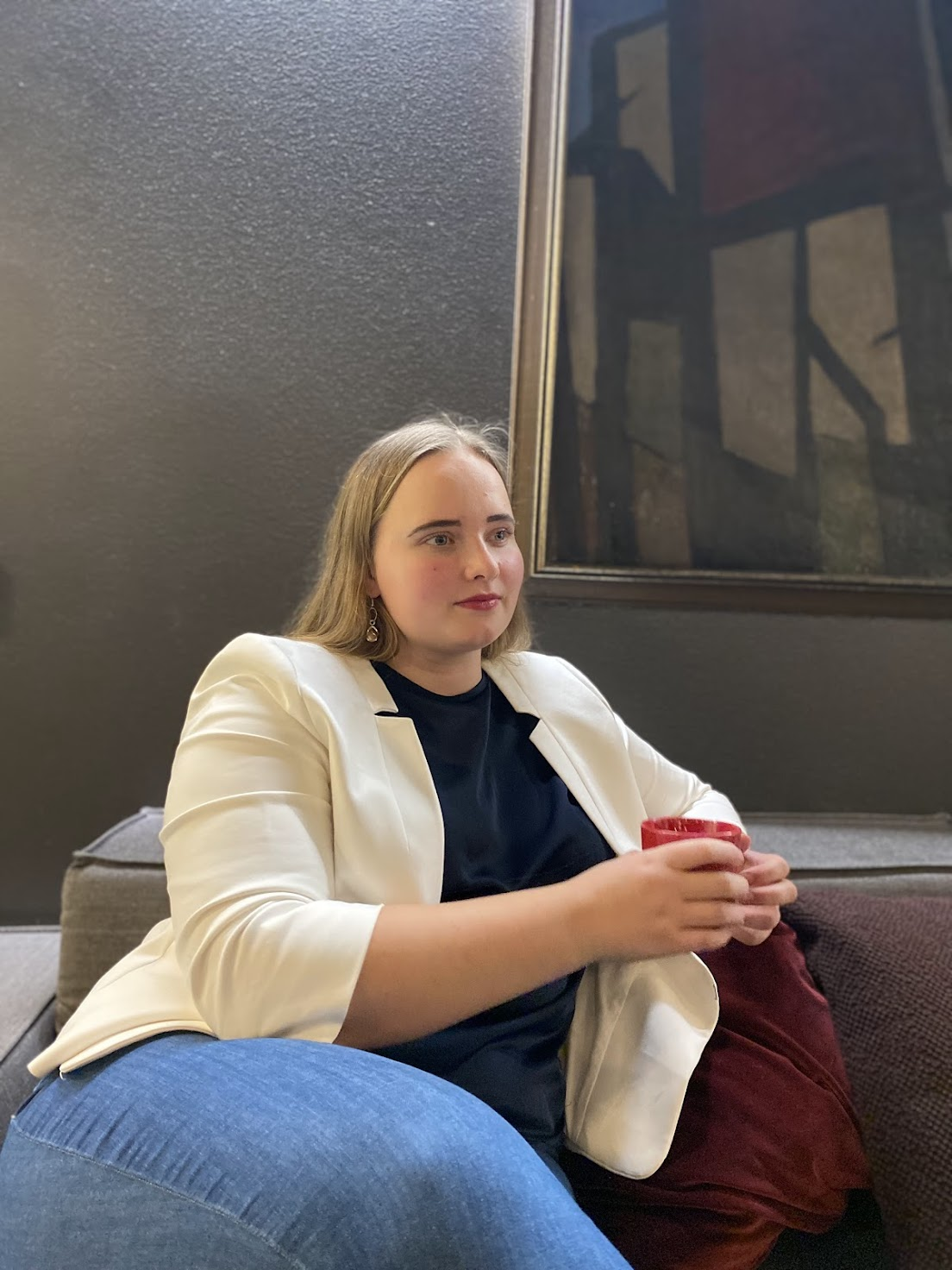
Back at the party headquarters, with refilled cups of tea to warm up after the short walk from the metro, Siru begins describing university representative councils as arenas where young politicians are shaped early.
Universities function as a political vanguard. Ideas are tested here before reaching parliaments. Future debates are formed here. On campus, decisions are made on issues that directly affect students’ lives: healthcare, housing, study conditions.
– “In Finland representative council elections are held every year in universities of applied sciences and every other year in universities.”
The student union runs its own lists. In some contexts it cooperates with the Greens and the Left. For many, it is the first time they participate in a political election at all.
– “Student councils make real decisions. It’s not a symbolic structure.”
This is where future municipal politicians, members of parliament, and organizers are trained. Campaigns are intense, resources are small, engagement is high.
At the same time, a paradox exists.
– “Some universities ban political organizations on campus.”
Students pay membership fees to their student unions, yet political organizing is restricted. Elections exist — but campaigns are pushed outside university grounds.
– “It’s a contradiction,” she notes.
When Hopealinna talks about students’ reality, election rhetoric disappears. She returns to one word: survival.
– “Mental health is the main issue. Student wellbeing — surviving academic pressure, graduating on time, the workload.”
It’s not only about individual wellbeing. It’s about structures that pressure students to produce credits at a pace many experience as unreasonable. In Finland there is a special foundation established by the National Union of University Students in 1954 called the Finnish Student Health Service (FSHS), whose mission is to provide healthcare, dental care, and mental health insurance for students. The healthcare fee costs €70 per semester, but queues are sometimes long depending on the city and help does not always reach the student in need.
– “The discussion is also about the amount of work required to accumulate credits.”
At the same time, the housing situation is a constant background noise. In several university cities there is a shortage of student housing. When the autumn term begins, some newly admitted students have nowhere to live.
– “In some cities there simply aren’t enough student apartments.”
The consequences are drastic. Some student unions rent temporary facilities and fill them with bunk beds. Shared kitchens. Shared bathrooms. Temporary solutions to permanent problems, where new students live until they manage to secure their own housing — often at high prices in larger cities.
– “We are already in a crisis.”
Previously the state financed student housing construction through loans and support. Those systems have been cut back. Construction has slowed.
– “It takes one and a half to two years to build a house,” she says.
For students, finances become a mathematical puzzle: rent, food, study aid, work.
– “Students have to choose between rent, food, and medicine.”
It is a sentence that lingers in the room.
When housing is missing, everything else is affected: academic performance, mental health, belief in the future. Student politics becomes, in practice, housing politics.
Del IV
Sverige, tvåspråkigheten och NATO
Sweden is never far away in Finnish politics. It becomes clear in the conversation almost immediately. The references come naturally — comparisons, warnings, role models. For Siru Hopealinna, the relationship with Sweden is both historical and practical.
Finland follows Sweden closely.
– “We look a lot at Sweden. Sometimes we copy good ideas. Sometimes we say: that didn’t work, we should avoid it.”
The Swedish-speaking minority is part of this closeness. Today about 290,000 people in Finland identify as Finland-Swedes, roughly 5% of the total population. Swedish remains Finland’s second national language, a historical legacy that continues to shape politics. The language issue sparks debate, especially from the Finns Party, which has long wanted to abolish bilingualism, but Hopealinna sees it in a broader perspective. She herself studied Swedish for five years in school but rarely uses it in everyday life; despite that, she understands the importance of continuing to learn the language.
– “Sweden is generally viewed very positively.”
The relationship is not only about culture and history. It is about social models. Integration, segregation, education policy — everything is studied across the Baltic Sea.
– “News about shootings and segregation reaches Finland quickly,” she says. “We try to learn from it.”
In new residential areas, Finland actively tries to avoid social division. Mixed housing models, schools designed to attract different groups, conscious urban planning.
– “For example, in my home city we introduced English-language school tracks to attract families to lower-income areas. We deliberately build supermarkets, schools, and housing to counter segregation. We want to avoid creating isolated residential zones.”
Finland chose to join NATO together with Sweden in 2022 — how do you view that decision?
Hopealinna remembers what the NATO debate looked like before Russia’s invasion of Ukraine.
– “Support for NATO membership was low.”
Then the war came and the public opinion shifted quickly.
– “Joining NATO was a good decision. It provides security.”
It is an observation rather than an ideological statement. Finland shares one of Europe’s longest borders with Russia. Security policy is not abstract. For many Finns, the decision was less about geopolitics and more about survival.
Doing it together with Sweden was decisive.
– “Doing it together with Sweden felt important — cooperation instead of acting alone.”
In that moment, the Nordic bond became military, not only cultural.
In Hopealinna’s description, the Nordic region returns as an idea. The countries differ, but share a social project: welfare, education, equality.
– “If we want to preserve the Nordic model, we have to cooperate.”
Youth and student movements are part of that cooperation. Platforms for Nordic dialogue are not merely symbolic — they are political tools.
And perhaps that is where the interview lands: in the idea that the future is not built nationally, but collectively.
Del V
Siru Hopealinna och framtiden
As the interview nears its end, the tone shifts. We move away from structures, numbers, and election results toward the person behind the title. The role of secretary-general of SONK sounds heavy, almost institutional. But when Siru Hopealinna explains how she got here, it sounds much more ordinary.
– “I didn’t even think of it as politics. I just wanted to organize things.”
She says it without irony. For her, engagement began not in ideology, but in practical work. Student councils, shared projects, the desire to make things function. Structuring, coordinating, getting people to cooperate. Politics came later as a language for something she was already doing.
The pandemic became a turning point. When everyday life paused, space opened for engagement.
– “I suddenly had time, and I filled it with politics.”
Unlike many others, she went directly into the party rather than through the youth or student organization. It was unusual, but logical for her. She did not see the steps as a career ladder, but as different entry points into the same work.
Sanna Marin’s time as prime minister became a source of inspiration, as did her family background in the labor movement. She considered joining the Greens but ultimately chose social democracy.
– “It’s a broader party, not focused on a single issue.”
At the same time, municipal elections were approaching, and the idea of running herself began to grow. In 2022 she joined SONK board but stepped down after the year. After a break of nearly two years, she returned in September 2024. After the congress she was elected second vice chair, and in October 2025 she became secretary-general.
She describes the student movement as less hierarchical than youth politics, more direct and practically oriented. Education policy is her driving force.
– “I believe every young person deserves an excellent education.”
Today she combines her engineering education with studies in administrative sciences. An engineer’s eye for systems meets an administrator’s understanding of structure. It shows in how she talks about politics: not primarily as ideological debate, but as construction.
At the same time, she sees a system under pressure.
– “The education system is heading downward. Students are the country’s future, but cuts are directed at us before adulthood has even begun.”
In her voice it sounds less like vision and more like responsibility. If students are the future, the system has to hold.
Recently she traveled to South Africa for a trade union training program. The experience became a contrast to Nordic normality.
– “It showed how privileged the Nordic region is.”
The differences were not abstract. They were concrete: working conditions, security, access to education. Seeing how other systems function — and fail — sharpens the view of one’s own.
Travel is therefore part of her future plans. She wants to work abroad, not as escape but as learning. To see more societies from the inside, not as a tourist but as a participant.
And somewhere on the horizon is a thought she still expresses cautiously.
– “And maybe in the future — this is more of a wishful thinking — I would like to work as an assistant for a minister or parliamentarian. I don’t know when, but it’s a dream.”
After a long conversation about SONK, Finland’s political system, student politics, and Siru’s history and future plans, one important question remains:
Favorite character in Moominvalley?
The answer comes immediately, with a laugh.
– “Little My.”
The small figure in a red dress, known for her sharp tongue and uncompromising energy. She smiles as she says it.
– “I relate to her personality lately. I try to be more like Moominmamma — calm, caring, steady.”
It is an image of balance fitting for a secretary-general: between drive and care, speed and stability.
Then she laughs again.
– “I want to be Moominmamma. But reality is mostly Little My.”
A short pause.
– “But I don’t bite.”
Outside, the rain over Helsinki has eased. Inside the party headquarters, the few who remain finish their tasks. Politics does not stop just because the interview ends — especially not for Siru, who is preparing for new meetings and discussions.
For Siru Hopealinna, student politics is not a parenthesis, not a youth phase to grow out of. It is present work.
“Students are the country’s future.” — Opiskelijat ovat maan tulevaisuus.
And in her world, the future is built through organizing — meeting by meeting, election by election, student by student.

Member discussion: